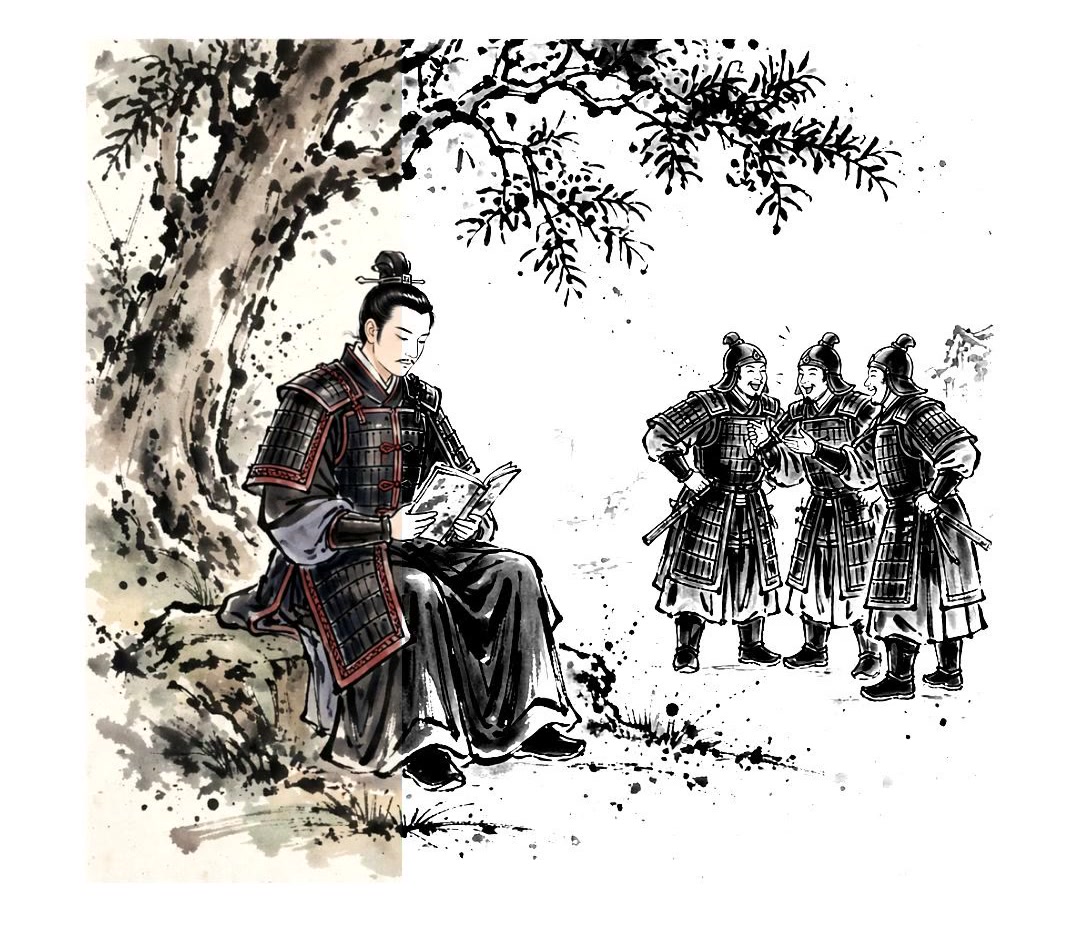
The General Under the Big Tree
The saying "lost in the east, gained in the west" comes from him.
1. The story
Nearly two thousand years ago, in the early days of the Eastern Han dynasty, there was a general named Feng Yi. He was one of the best soldiers of his time — and the quietest.
After every victory, the other generals would gather together to boast about who had done the most. Feng Yi never joined them. He would slip away on his own, sit down under a big tree, and read a book. The soldiers noticed. They gave him a nickname: 大树将军 — the General Under the Big Tree.
In the year 27, the young dynasty faced a rebel army called the Red Eyebrows, named for the red paint on their brows. Feng Yi had a plan: win them over slowly, with trust and patience. Block them at Mianchi in the east, and strike from the west. It was the careful plan — and the other commanders overruled him. They attacked head-on, and were routed. Feng Yi abandoned his horse and climbed the slope at Huixi on foot, with only a handful of men beside him.
He did not argue. He did not quit. He gathered his scattered soldiers, picked several thousand of his best, dressed them in the rebels' own clothes, and hid them in ambush at Mianchi. The next day the two armies met, and when the fighting was at its hardest, his "rebels" burst out of hiding. The real rebels looked around and saw their own men fighting their own men. Panic. Chaos. Tens of thousands laid down their arms on the spot.
The emperor wrote Feng Yi a letter. "At first your wings drooped at Huixi," it said. "In the end they spread at Mianchi. You lost in the east, and gained in the west."
In Chinese:
始虽垂翅回谿,终能奋翼黾池,可谓失之东隅,收之桑榆。
东隅 is the morning sun, rising in the east. 桑榆 is the evening sun, sinking behind the mulberry and elm trees in the west. A morning lost. An evening won. (黾池 and 渑池 are two writings of the same place.)
2. Why it matters today
Chinese people still say this line every day — for a failed exam, a lost job, a missed chance, a business that went the wrong way. It is the opposite of "it's all over." It says: the day is not finished yet. What you lost in the morning, you can still win back before sunset.
And notice how Feng Yi did it. He was not the loudest man in the room. He was the quiet one under the tree. He lost a battle in the morning and did not let the morning decide the whole day. He went back, thought again, and tried a different way — a quieter way, a smarter way. That is the whole saying in one man: a loss is a place, not a verdict. You can lose in the east and still gain in the west, because the sun has not set yet.
3. One thing to do
This week, when something goes wrong, say the line out loud: Shī zhī dōng yú, shōu zhī sāng yú — lost in the east, gained in the west. Then write down one thing the same day gave you back. Keep the note where you can see it. The day isn't over until the sun sets.
Words to keep:
- 失之东隅,收之桑榆 (shī zhī dōng yú, shōu zhī sāng yú) — lose in the east, gain in the west
- 大树将军 (dà shù jiāng jūn) — the General Under the Big Tree
4. Watch it — 60 seconds
Source: the story is told in Fan Ye's Book of the Later Han (后汉书), "Biography of Feng Yi" (冯异传), and in Sima Guang's Comprehensive Mirror (资治通鉴), volume 41. The emperor's letter is quoted word for word.